Identify the Character of a Sound
Two instruments can play exactly the same note at the same loudness and still sound unmistakably different. That difference — timbre, or tone colour — is what this page teaches you to describe.
What makes a sound's character
Timbre comes from several features working together. You do not need the physics to hear them, but a few words make them easier to notice:
- Attack — how the sound begins. A plucked guitar string starts with a sharp edge; a bowed cello note can swell in gently.
- Sustain and decay — whether the sound holds steady, like an organ, or fades away, like a piano or a bell.
- Overtones — faint higher tones ringing inside every note. Their balance is a large part of why a clarinet sounds hollow and an oboe sounds reedy and focused.
- Noise — breath, bow scrape or key clicks that are part of an instrument's identity.
Describe first, name second
When an unfamiliar sound appears, resist the urge to guess the instrument straight away. Describe it with simple pairs of opposites: bright or dark, breathy or clear, sharp start or soft start, held or fading, thin or full. Two or three honest descriptions will lead you to the right instrument family far more reliably than a quick guess — and when the name is still unclear, your description remains accurate and useful.
Families at a glance
Sorting by how a sound is made is the gentlest route into instrument recognition.
| Family | How the sound is made | Examples | Listening clues |
|---|---|---|---|
| Strings | Bowed or plucked string | Violin, cello, harp, guitar | Bowed: smooth swells. Plucked: sharp start, quick fade. |
| Woodwind | Air across an edge or through a reed | Flute, oboe, clarinet, bassoon | Audible breath; reeds add a buzzy or nasal edge. |
| Brass | Lips buzzing into a cup mouthpiece | Trumpet, French horn, trombone, tuba | Bright when loud, rounder when soft; strong attack possible. |
| Percussion | Struck, shaken or scraped | Timpani, snare drum, xylophone | Clear attack; often fading quickly. |
| Voice | Vocal folds and the shape of the mouth | Soprano, tenor, choir | Vowel shapes and words; the most familiar timbre of all. |
Pieces written for this kind of listening
Sergei Prokofiev wrote Peter and the Wolf (1936) to introduce children to the orchestra, and it works beautifully for adults too. Each character has an instrument: the bird is a flute, the duck an oboe, the cat a clarinet, the grandfather a bassoon, the wolf three French horns and Peter himself the string section. A narrator tells you who is who, so you can match sound to label with no guesswork.
Benjamin Britten's The Young Person's Guide to the Orchestra (1945) takes a theme by Henry Purcell and passes it through every section in turn. Ravel's Boléro repeats one melody many times, changing only the instruments — a perfect side-by-side comparison of tone colour.
Ordered listening prompts: one melody, many colours
- Choose Boléro or Peter and the Wolf and set a comfortable, moderate volume.
- Listen to the first appearance of the melody. Write two descriptive words, nothing more.
- At the next appearance, write two new words. What changed?
- Decide the family: blown, bowed, struck or sung?
- Check the programme notes or narration to find the instrument's name.
- Replay the two passages you found most alike and listen only for the attack.
Everyday sounds count: a kettle, a door hinge and rain on a window all have timbre. Describing them with the same opposites is excellent practice, and no instrument is required.
Timbre exercises
 Timbre
Opposite pairs
Describe each new sound with three opposite pairs before naming anything.
Ask about this exercise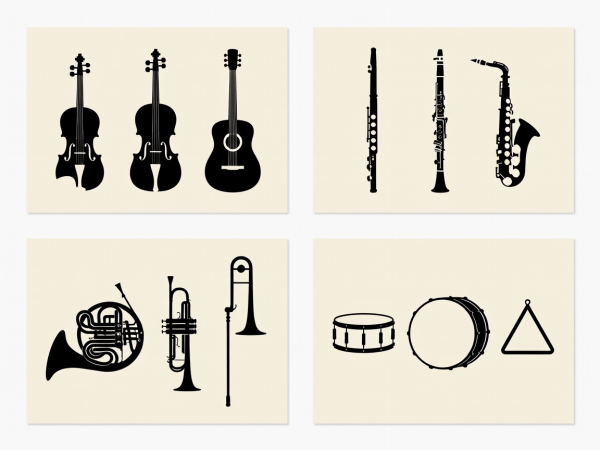 Families
Sort by family
Hear a short passage and place it in one of four boxes: bowed, blown, buzzed or struck.
Read listening help Attack
Sharp or soft start
Listen only to the first moment of each note. Plucked and struck sounds will stand out.
Link to pulse practice